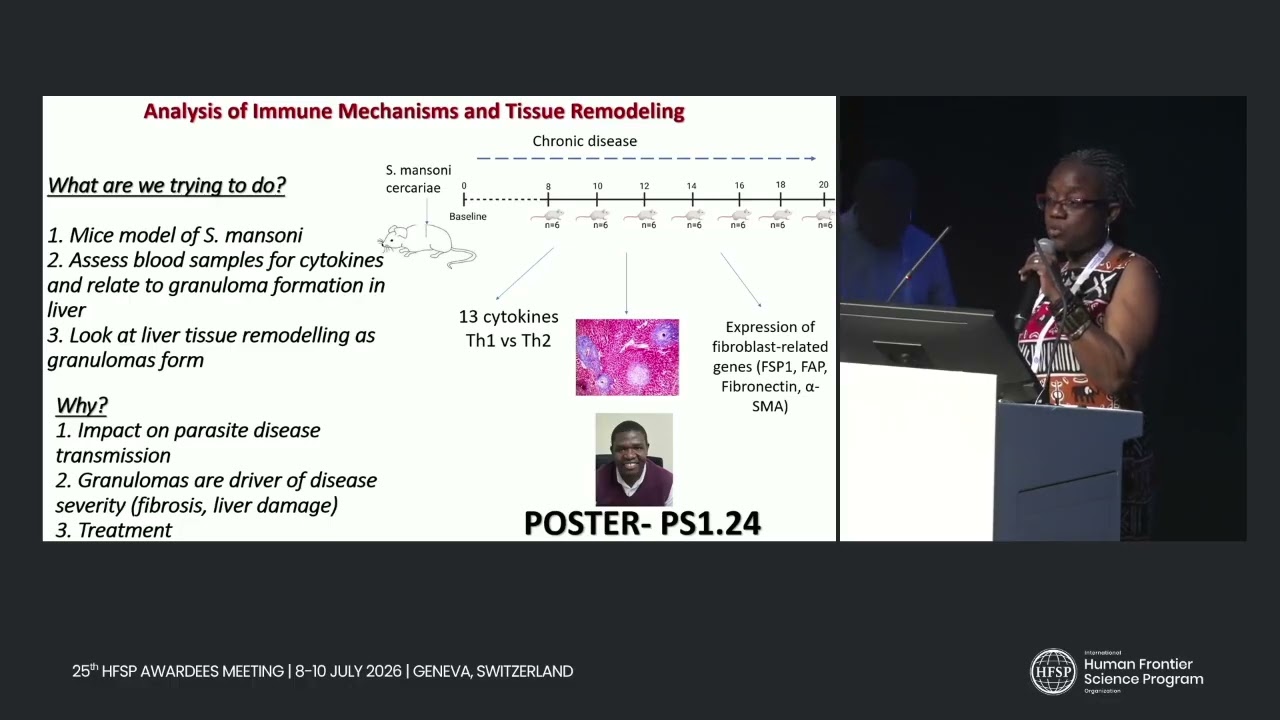
Talk by Lucy Ochola, Centre for Research and Therapeutics and Institute of Primate Research, Kenya, at the 25th HFSP Awardees Meeting, 8-10 July 2026, Geneva, Switzerland.
ABSTRACT
Schistosoma mansoni, the causative agent of intestinal schistosomiasis, remains a major public health challenge in tropical regions. A central enigma of infection is the migration of parasite eggs despite lacking intrinsic motility through host tissues to the intestinal lumen for excretion. While endothelial cells have been implicated in this process, the contribution of other cell types, particularly fibroblasts, is poorly understood. Moreover, the factors determining whether eggs successfully reach the gut lumen or become trapped in tissues, leading to granuloma formation and pathology, remain unclear. Elucidating these mechanisms may reveal new strategies for controlling S. mansoni infection and associated disease burden.
This study aims to investigate egg migration within the complex host environment by integrating analyses of tissue remodeling, immune responses, and egg gene expression during infection. To clarify host immune responses at different phases of infection, a longitudinal study was performed. Mice were infected with S. mansoni cercariae and sampled weekly for fourteen weeks to assess the kinetics of key cytokines associated with dynamic host-parasite interactions across infection stages.
Th1/Th2/Th17 associated cytokines (IL-4, IL-10, TNF-α, IFN-γ, IL-33, IL-17) were profiled using Luminex and further correlated with immune cell populations (CD4, CD8, CD25, CD 31, CD 68) that were assessed via flow cytometry. We found that cytokine levels tend to fluctuate as infection progresses, with key Th2 cytokines (IL-4 and IL-10) increasing during the chronic phase of disease. These cytokine levels could be associated with T cell differentiation and immune regulatory responses. To visualize cellular interactions and tissue remodeling associated with granuloma formation, studies are ongoing to examine how the remodeling of the extracellular matrix occurs in the liver tissues around migrating eggs using immunohistochemistry, and to establish how the remodeling correlates with the expression of fibroblast-related genes (FSP1, FAP, Fibronectin, α-SMA) to be quantified using quantitative PCR.
Together, these approaches will unravel the cellular and molecular mechanisms that govern egg migration and entrapment, advancing our understanding of schistosomiasis pathology and potential avenues for intervention.
KEYWORDS
Schistosomiasis, fibroblasts, cytokines, granuloma, gene expression
- Category
- Try Not To Cum
Commenting disabled.
Up Next
Autoplay
-
10:35

How to FLATTEN ZOMBIES with a MECHANISM in Minecraft ? CHALLENGE 100% TROLLING !
-
10:01

Egg boiled cooking | first time no hand only mouth egg boil eating | eating challenge | eating show
-
56:21

Preparing the Nomads for Migration, a narrative of the hardships and challenges of nomad migration♥️
-
ALL STEAL AN EGG PETS GOT MARRIED IN THE NEW STEAL AN EGG CONCERT UPDATE !!
-
01:00
Why does Lil Mixins use hard boiled egg in the egg powder instead of raw? #ChackoAllergy
-
00:11

Hot lynx twerk ???????????? [MUST WATCH] [TRY NOT TO CUM]
-
02:41

TRY NOT TO CUM: CSGO EDITION V2
-
05:56

Try Not To Cum ???????? | Cute & THICC TikTok Girls ???????? #6
-
00:14

Try not to cum challenge
-
24:57

[ASMR] TRY NOT TO CUM???????? (gone sexual)